Reading is Human

Carl Jung warned that the world will ask us who we are, and if we do not know, the world will tell us.
When individuals lack an inner life, they become vulnerable to external forces that shape identity, values, and meaning.
For this reason, strengthening one’s interior world is not optional. It requires protecting our thoughts and the way we make meaning. Reading is one of the primary ways this protection has historically been achieved.
In recent years, attention has become one of the most studied, and strained, human capacities. Research summarized by the American Psychological Association shows that sustained focus has declined alongside the rise of digital devices. Notifications, alerts, and constant task-switching interrupt continuous thought and makes it difficult to remain with any idea for long.
What is often described and framed as a “crisis of attention” because of digital tools, can more accurately be positioned as the fragmentation of the individual’s interior life.
This fragmentation is not accidental. It is structural. Modern environments are designed to divide attention, not to preserve it.
Being able to hold attention to a thought allows meaning to form. A sustained thought moves in the mind from a piece of information to understanding that thought, and finally to deriving insight from that thought. This allows for complex thinking, and ultimately sustained attention allows us to be able to follow cause and effect, weigh multiple perspectives, notice nuance, and tolerate ambiguity. All of this is the foundation of moral reasoning, ethical judgement, serious creativity, philosophy, science, and art.
A complex thought cannot occur without time to process it, and this process helps build an interior world. One’s interior world is made up of remembered ideas, internal dialogue, symbolic associations, and personal meaning. Without an interior world, the mind becomes reactive and not reflexive.
Processing thoughts strengthens identity and agency.
When you can remain with a thought, you decide what matters, you are able to form your own judgements, and you then resist being pulled by multiple stimuli. This is why Carl Jung tied interiority to moral responsibility. If you can sustain attention, you have a strong inner authority.
Sustaining a thought trains patience and emotional regulation. Remaining with difficult ideas trains the same capacities as staying with discomfort, not fleeing uncertainty, not demanding instant resolution. And this is why reading, thinking, and emotional maturity are deeply linked.
Now, what happens when you cannot maintain a thought? And please note, this is not a moral failure but a cognitive and cultural condition that does have real consequences.
When you cannot sustain a thought, meaning collapses into reaction. When your attention is fragmented thoughts do not mature, your ideas are replaced before they can fully develop, and opinions are formed instantly and defensively. You react. You do not reflect.
Being unable to sit with thoughts for a long time makes complexity intolerable. Without the ability for sustained attention, nuance feels exhausting, ambiguity feels threatening, long term disagreements and arguments feel hostile or boring. People gravitate toward slogans, binaries, outrage, and certainty without understanding. This condition creates an identity that becomes externally supplied. If you cannot sit with your thoughts long enough to form meaning identity is borrowed, values are absorbed from the loudest voice / loudest source, and selfhood becomes performative. Ethical reasoning weakens, and ethics require holding competing values, delaying judgement, and imagining consequences. Fragmentation of ideas short-circuits this entire process. Right and wrong then become: What feels good now? What aligns with the group? What earns approval? The self becomes porous: Where do you start? Where do you stop?
When you cannot sustain a thought the boundary between yourself and the environment thins. Moods, narratives, and emotions are easily transmitted. In these conditions, the mind is aways open, but not in a good way because this leads to volatility, hostility, and exhaustion.
Sustained thought produces depth.
Interrupted thought produces surface.
If you lack the ability to sustain focus on a single thought and to make meaning of it, you are at risk of having your next thought chosen for you by another person, by an advertisement, or by whatever source is vying for your attention.

Unlike algorithmic media, reading requires us to slow down and engage with the text in front of us. A book does not respond to us. It does not personalize itself or optimize its settings for engagement. It unfolds according to its own internal logic and demands our sustained attention, interpretation, patience, and tolerance for ambiguity.
Literature was shaped in a way to support our interior life. When we engage in reading, deep reading, we’re not only strengthening our interior world and our focus, but we are also shaping what we see, what we ignore, and what we value. Over time, reading helps form a steadier self, one who is less reactive and more deliberate.
To read is to think, is to be human.
How to read more (not necessarily more books, but just more than you are reading now)
Separate reading from devices entirely: Put your phone in another room while you are reading. Even the presence of a phone while reading fragments attention.
Read fewer books at once: Consumer culture trains us to want to purchase all of these books. Stop. Pick one book. Read at your pace. Do not allow the algorithmic world to pressure you into thinking you must read quickly. Enjoy reading slowly and for depth.
To absorb information, take notes: Journal about what you’ve read. Highlight passages. Write in the margins (If it’s your book.). Write a summary of what you read, in your own words, after each reading session.
Use a dictionary or thesaurus: If a word, or a passage, is confusing, highlight it. Return to it. Look up words in the dictionary and/or thesaurus.
Treat reading as an appointment: Even briefly, set aside 10 minutes and work your way up.
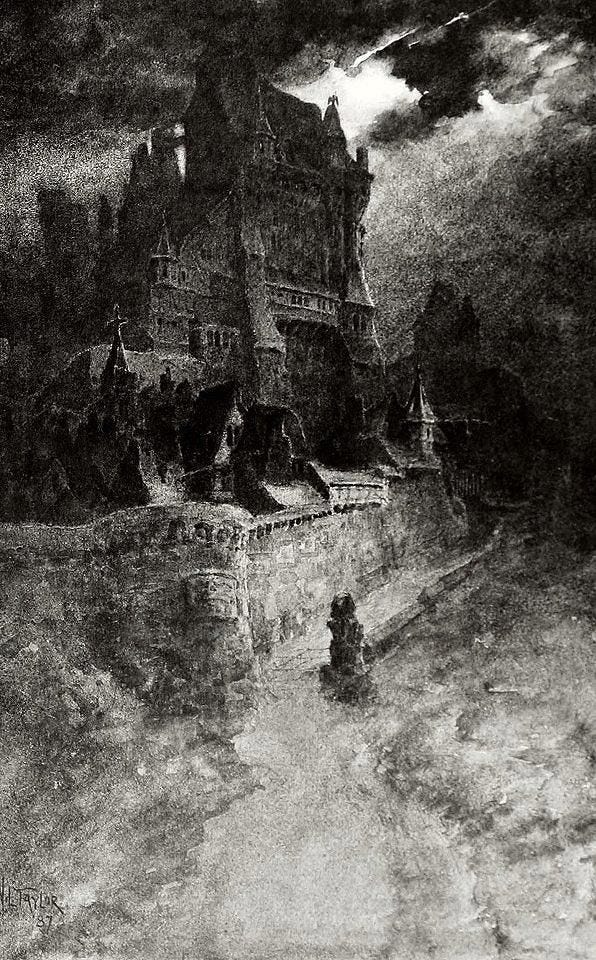
Gothic Reading
This month’s Gothic reading is the novel that began the Gothic genre, The Castle of Otranto by Horace Walpole, published in 1764. I’ll write about it more next time.
Creative Writing Essentials with me at StoryStudio in Chicago
I’ll be teaching Creative Writing Essentials at StoryStudio. The details can be found here.
Where to Find My Novels
My recent novels can be found here.
-Cynthia
91